What Is Tinder Lookup? How It Works and Why It's More Reliable Than Swiping
Tinder lookup is a structured way to check if someone has an active Tinder profile — without creating your own account or relying on the app's swipe feed. Here's exactly how it works, what data it uses, and when it's worth using.
What Is Tinder Lookup? How It Works and Why It's More Reliable Than Swiping

Tinder lookup is a structured process for checking whether a specific person has an active Tinder profile — without creating your own account and without relying on the app's swipe feed to surface them.
If you're here because you searched tinder lookup, tinder look up, or tinder profile lookup, the answer you're looking for is: yes, this is a real thing, it works differently from swiping, and the quality varies dramatically between tools. This guide covers all of it — how the process works, what to expect from a reliable service, and what the limitations actually are.
Quick answer
A structured lookup uses identifying details — typically a name, approximate age, and city — to assess whether a matching Tinder profile is likely active. It doesn't rely on Tinder's algorithm deciding to show you that person. That's the core difference from swiping: instead of waiting for exposure, you're running a targeted check.
Tinder lookup vs Tinder profile search
People use "Tinder lookup", "Tinder profile search", "Tinder checker", and "Tinder finder" for the same basic goal: they want to know whether a specific person is active on Tinder. The labels are different, but the important question is the method behind the search.
A basic profile search usually implies a public directory where you type a name and browse matching profiles. Tinder does not offer that. There is no official name search, phone search, or profile database available to the public. A Tinder lookup, when done responsibly, is closer to structured signal matching: you provide identifiers, and the system evaluates whether those identifiers point to likely active Tinder activity.
That distinction matters because a real lookup should not pretend to show every profile on Tinder. It should explain what it can infer, what it cannot know, and how confident the result is.
Why this exists in the first place
Tinder has no native search bar. You can't type someone's name into the app and find them. What you see is an algorithmically controlled feed — and that algorithm decides who appears in your queue based on dozens of signals you have no influence over.
This creates a specific problem: if you want to know whether one particular person is active on the platform, the app itself gives you no direct way to find out. For the full breakdown of what is and isn't possible natively, see can you search for someone on Tinder.
Most people try the obvious workaround — create a Tinder account, set the filters to match, and start swiping. It feels logical. In practice, it has three structural problems that make it unreliable for any person-specific check.
First, visibility is never guaranteed. Two people can be in the same city, in the same age range, both actively using Tinder, and still never appear to each other. The platform manages profile exposure through internal ranking signals — being on the app doesn't mean being visible to everyone on it.
Second, your own profile becomes visible the moment you go active. That means the person you're checking may see your profile before you find theirs. In a sensitive situation, that changes everything before you have any useful information.
Third, there's no finish line. After hours of swiping you have no way to know whether the person isn't on Tinder or simply wasn't shown to you. The method produces no result you can actually interpret.
A dedicated lookup tool exists to get around all three of these problems.
How the process actually works
A structured lookup follows roughly this sequence:
You provide identifiers. First name, approximate age, and general location — the city or region where the person is likely based. Some tools also accept a photo for additional cross-referencing.
The system runs matching logic. These identifiers are processed against available profile signals to assess whether a likely active match exists. This is not a direct database query — Tinder does not allow API access to third parties — but a signal-based detection approach designed to reduce false positives.
Results are assessed for confidence. A responsible tool doesn't just return "found" or "not found." It presents what was detected, at what confidence level, and what contributed to that assessment. This framing matters. In an emotionally charged situation, a weak signal presented as certain causes real damage.
You receive a structured report. Typically within 24 hours. What it should clearly distinguish: a probable active match, a partial or uncertain signal, and no meaningful match detected.
That four-step process is what separates a lookup from swiping — it's targeted, it's bounded, and it gives you something you can actually interpret.
What it is not — and this part matters
There's a lot of misleading marketing in this category, so being clear about what the process genuinely cannot do is important.
It's not direct database access. Tinder doesn't provide API access to outside services. Any tool claiming it can instantly query Tinder's full live database is overstating what's technically possible. What's realistic is indirect signal matching — and a trustworthy service will say so.
It's not 100% accurate. Profiles with minimal public information are harder to identify confidently. Matching signals can be ambiguous. A reliable tool tells you this and frames results accordingly, rather than always returning a definitive answer.
It's not a substitute for certainty. A lookup result — even a strong one — is a signal, not proof. It narrows uncertainty significantly, which is often exactly what someone needs before deciding whether to have a direct conversation. But it shouldn't be treated as the final word in isolation.
Can you do a Tinder lookup without an account?
Yes, that is one of the main reasons people use a dedicated lookup service. Manual swiping requires creating or reactivating your own Tinder account, which can expose your profile to the same person you are trying to check. It also gives you no clear endpoint: if they do not appear, you still do not know whether they are absent or simply hidden by Tinder's feed.
A private lookup is different. You do not need to install Tinder, create a profile, or appear in anyone's swipe queue. You provide the details needed for matching, and the process runs independently. That does not make it magic or guaranteed, but it does remove the biggest privacy and exposure problems with manual searching.
The difference between a good tool and a bad one
The category has low barriers to entry. Many tools exist that are built primarily to take payment, not to deliver useful answers.
Low-quality services tend to show patterns like: results returned almost immediately regardless of input quality, attractive but generic profile images presented as matches, urgency and fear language used before any evidence of accuracy, and no explanation of methodology or confidence levels.
Higher-quality services do the opposite. They explain how matching works in plain terms. They distinguish between strong signals, partial matches, and inconclusive results. They don't manufacture output when confidence is low. And they're transparent about pricing before checkout.
DoTheySwipe is built around the second set of standards. It uses structured signal matching, reviews findings before delivery, and won't return a manufactured result when the underlying signals don't support one. You can review the latest customer feedback on Trustpilot.
Pricing and what to expect
Structured lookup is a paid service. There's no free equivalent that offers comparable reliability.
Free manual alternatives exist — mainly creating your own Tinder account — but they're slower, structurally unreliable for person-specific checks, and expose your own profile in the process. The cost of "free" in this context is meaningful.
Free Tinder lookup tools do exist — but they all rely on the same manual swiping method described above, which means creating your own account and waiting for the algorithm to surface the person. That's not really a "lookup" — it's just swiping without a better name. Structured account-level detection, the kind that works without a Tinder profile of your own, requires the matching infrastructure that paid tools are built around.
DoTheySwipe charges $24.99 for a single search and $34.99/month for a recurring weekly scan that monitors for changes. Both prices are displayed clearly before checkout.
When it makes sense to use this
A structured lookup is most useful when:
- Manual swiping has already failed or feels too risky
- You want to check without creating your own Tinder profile
- The app may have been deleted from a device but you suspect the account is still active
- You want a faster path to clarity before deciding whether to have a direct conversation
It's less useful when the identifiers you have are extremely vague — only a first name, no location, no age context. The matching logic needs something to work with.
One thing worth knowing: if you have natural, non-forced access to the person's phone, checking the device directly is still faster and produces higher certainty than any third-party tool. App presence, notification history, and data usage are all concrete indicators. A lookup fills the gap when direct access isn't available. For the full decision sequence — which approach to use first, second, and third — see the guide on how to check if your partner is on Tinder.
The bottom line
A Tinder lookup is a more structured and targeted alternative to manual swiping — one that doesn't expose your own profile, doesn't depend on algorithmic luck, and gives you a bounded result you can actually interpret.
It's not magic, and a good service won't pretend it is. What it offers is a meaningful reduction in uncertainty, delivered within 24 hours rather than days of guessing.
If you want to run one now, DoTheySwipe takes about a minute and the person you search for is never notified.
🔒 Payments via Stripe · Completely anonymous · See latest Trustpilot reviews · No Tinder account needed
Frequently asked questions
What is the difference between Tinder lookup and swiping? Swiping is passive — you see whoever Tinder's algorithm decides to show you, with no control over whether a specific person appears. A lookup is active and targeted: you provide identifiers, the system assesses whether a matching profile is active, and you get a bounded result. It doesn't depend on algorithmic exposure.
What is the difference between Tinder lookup and Tinder profile search? A Tinder profile search sounds like browsing a public directory, but Tinder does not provide one. A Tinder lookup is better understood as a structured check that uses identifiers and available signals to assess whether a matching profile is likely active.
Can I do a Tinder lookup without creating a Tinder account? Yes. DoTheySwipe is designed for people who want to check privately without installing Tinder, creating a profile, or becoming visible in the swipe feed.
Does DoTheySwipe actually work? Yes. It uses structured signal detection and human review rather than random profile galleries or automated outputs. Results are assessed before delivery, and the service doesn't manufacture matches when the underlying signals are weak. For current customer feedback, see Trustpilot.
Can it ever be 100% accurate? No third-party service can guarantee that. Tinder doesn't provide API access to outside tools, so all lookup services work through indirect signal matching. A trustworthy tool frames results by confidence level and is honest about ambiguous cases — that's what separates it from services that always return a definitive "found."
Can it still detect a profile if the Tinder app was deleted? Often yes. Deleting the app from a phone doesn't delete the Tinder account — the profile remains on Tinder's servers. Account deletion requires a separate in-app step that most people don't take. So the account may still be detectable even if the app is gone. More on this in the partner check guide.
Is it free? No. DoTheySwipe charges $24.99 for a one-time search and $34.99/month for a recurring weekly scan. Free manual alternatives exist but they're slower, less reliable for specific-person checks, and make your own profile visible in the process.
How long does it take? Results are typically delivered within 24 hours. Manual swiping has no defined endpoint — you can search for days with no way to distinguish "not found" from "not shown to you."
What information is needed? First name, approximate age, and general location (city or region). No email address, phone number, or Tinder username is required.
Will the person know they were searched? No. The process runs independently of Tinder and the searched person receives no notification of any kind.
Can you look up someone on Tinder without an account? Yes. A structured lookup runs independently of Tinder's app, so you don't need to create a profile, install the app, or appear in anyone's swipe feed. This is the main practical difference from manual searching.
How accurate is a Tinder lookup? Accuracy depends on how specific the identifiers are. A first name plus approximate age plus a specific city produces a much more confident assessment than a first name alone. No third-party tool has direct Tinder API access, so every result is a confidence-framed signal rather than a database confirmation.
Looking for Someone?
Our search tool can help you find dating profiles and verify online activity with just a name.
Related Articles
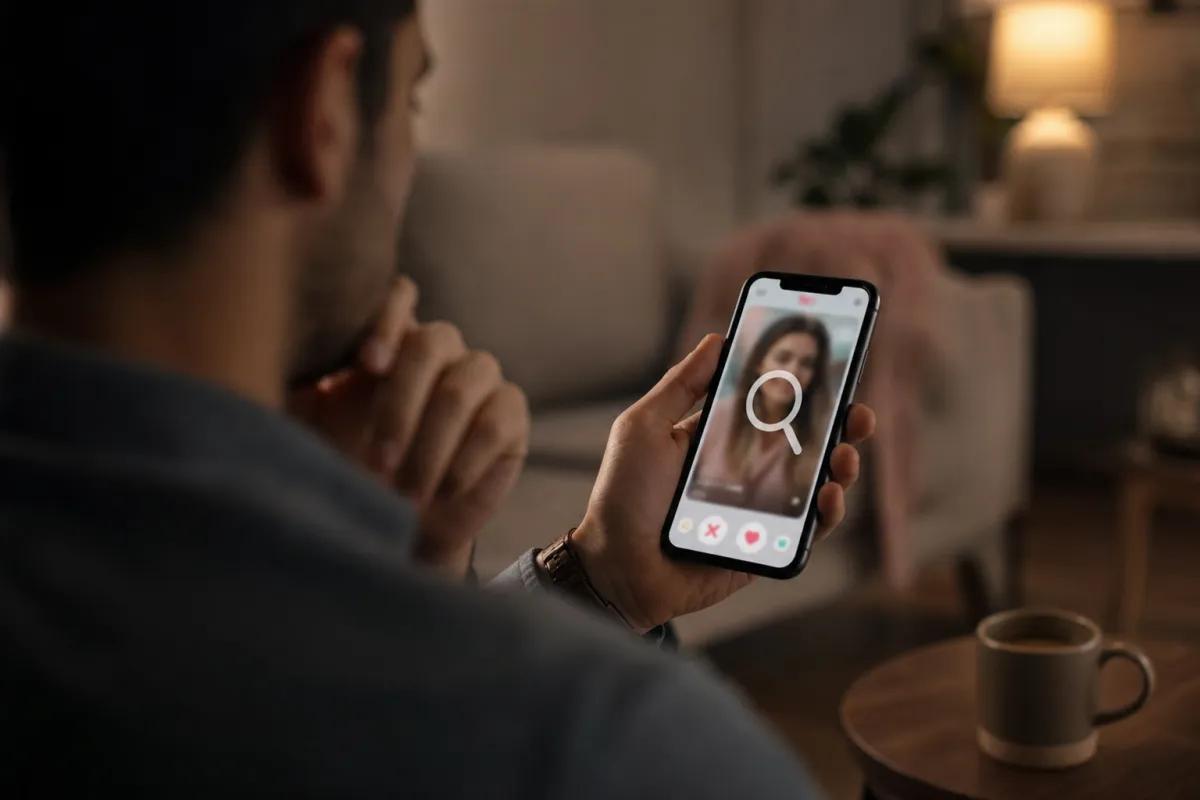
Can You Search for Someone on Tinder? What's Actually Possible in 2026
Tinder has no search bar and no public profile directory. Here's what that means in practice, what workarounds exist, and which ones actually produce a usable answer.
Tinder Search Engine: Why Most Tools Do Not Work
Most Tinder search engines fail because Tinder has no public profile directory. Learn the difference between Tinder search engines, checkers, lookups, and finders.

Why Tinder Finders Are in High Demand
More people than ever search for Tinder Finders. Here's why the demand exploded and why DoTheySwipe became the trusted choice for online dating clarity.