Signs Your Husband Is on Tinder (And What to Do About It)
Something feels off but you're not sure? Here are the behavioral signs that often accompany hidden Tinder activity — and how to find out for certain without confronting him first.
Signs Your Husband Is on Tinder (And What to Do About It)

Most people who search this aren't looking for drama. They noticed something — a small shift in behavior, an inconsistency that didn't resolve itself — and now they're wondering whether what they're sensing has a real basis.
This guide covers the behavioral signs that most commonly accompany hidden Tinder activity, why those signs appear, and what to do if you want a clearer answer before deciding whether to have a direct conversation.
Why behavioral signs matter before you check
The instinct to look for proof first is understandable. But in practice, most people notice changes in behavior long before they find concrete evidence. Those behavioral shifts aren't nothing — they're often more informative than people give them credit for.
The signs below aren't definitive on their own. But when several appear together, consistently, over time, they carry real weight. Patterns are harder to fake than isolated moments.
Phone behavior changes
This is usually the first thing people notice, and it's the most consistent signal across almost every situation involving hidden app activity.
The phone faces down more often. Previously it sat wherever — on the table, on the counter, screen up. Now it's almost always screen-down or in a pocket.
Notifications get silenced or hidden. Notification previews that used to be visible are suddenly turned off. The lock screen shows nothing. He picks up the phone immediately when it buzzes, before you can see anything.
The phone goes everywhere now. Bathroom, bedroom, every room he moves to. This is different from normal phone use — it's phone use that seems oriented around keeping the screen out of view.
The passcode changed. Or there's suddenly a passcode where there wasn't one before. If you've ever casually used his phone before and that access has become noticeably harder, that's worth noting.
None of these are proof of anything alone. But most people in this situation describe phone behavior as the first concrete thing they noticed — before anything else became visible.
Timing and availability patterns
Tinder and most dating apps require active engagement. That time has to come from somewhere.
He's on his phone late at night. Not occasionally — consistently. After you go to sleep, or while you're occupied elsewhere. The timing often correlates with when Tinder activity is highest: evenings and late nights.
Response times to your messages have gotten unpredictable. He used to reply relatively consistently. Now there are stretches where he's clearly active on his phone but not responding to you.
He steps out to take calls or "just needs a minute" more often. Short absences that feel slightly off — not explained, just routine enough to go unquestioned.
Bathroom time has increased noticeably. This sounds trivial, but it's consistently mentioned in accounts of discovered dating app use. Private time with the phone.
Emotional and relational shifts
Behavior on a dating app tends to affect behavior at home, even when someone is trying to keep things normal.
Increased irritability or distance without a clear reason. The presence of something to hide creates low-level tension that surfaces as mood. Small things become bigger reactions.
Less interest in shared activities or conversation. The emotional investment that's going somewhere else has to come from somewhere. If he seems more distracted or less engaged than usual, that's a shift worth tracking.
Sudden increased attention — the overcorrection. Sometimes the opposite happens. He becomes unusually attentive, helpful, or affectionate. This can be guilt-driven behavior and is worth noting if it appears without explanation alongside other signs.
He's more defensive about privacy than he used to be. Questions that would previously have been answered casually now get short or deflective responses. The threshold for what counts as "intrusive" has shifted.
Digital footprint changes
Beyond the phone itself, there are sometimes external signals that something has changed.
New contacts or social media followers you don't recognize. Especially if they don't fit his existing social circle — different age range, no clear connection to work or existing friends.
Instagram activity has changed. Tinder allows users to link their Instagram. If he's suddenly posting more, or getting engagement from unfamiliar accounts, that can be a secondary signal — though circumstantial.
Data usage has increased without explanation. Tinder is a data-heavy app. On most phones, you can check per-app data usage. If Tinder appears in the list — or if overall mobile data has spiked without a clear reason — that's a concrete indicator.
Google or browser history gaps. Not that you're checking — but if you happen to notice that history is being cleared more regularly than before, that's a behavioral change.
What these signs actually tell you
The important thing to understand is that none of these signs confirm Tinder use on their own. Phone privacy could reflect a work situation. Late-night phone use could be something completely unrelated. Emotional distance can have dozens of causes.
What matters is the pattern. One sign, explained away, isn't much. Three or four signs, appearing together, persisting over time, and pointing in the same direction — that's different. That's when a vague feeling becomes something worth addressing.
The question then becomes: do you want to have a direct conversation first, or do you want a clearer answer before that conversation happens?
What to do if you want a clearer answer first
Many people find that going into a direct conversation with verified information — rather than a feeling — changes the dynamic significantly. You're not asking whether something is happening. You're asking about something you already know.
If you want to verify independently before confronting, there are two practical paths:
Check his phone directly — if that's natural in your relationship. Look for the app itself (a Spotlight search for "Tinder" on iPhone takes two seconds), notification history, or data usage under Settings. This is the fastest method when access is available. For the full breakdown of this and other approaches, see how to check if your partner is on Tinder.
Run a structured search — if direct access isn't available or feels too risky. DoTheySwipe uses name, age, and location to assess whether a matching Tinder profile is active. It's completely anonymous — he's never notified — and takes a few minutes. This is particularly useful if the app has been deleted from his phone but you suspect the account may still exist.
A note on what finding something means
If you do find an active profile, it doesn't automatically answer everything. An account created before your marriage and never deleted is different from a recently updated profile with current photos. Recent activity signals — profile changes, active status — carry more weight than mere account existence.
What you do with the information is entirely your decision. Some people confront directly. Others take time to process first. What almost everyone reports, looking back, is that knowing was easier to navigate than the sustained uncertainty of not knowing.
If the signs above resonate — if several of them are present and consistent — that feeling probably has a basis. It's worth finding out.
Frequently asked questions
How can I tell if my husband is on Tinder without checking his phone? The most practical anonymous method is a structured detection tool like DoTheySwipe. You provide his name, approximate age, and location — the search runs independently of Tinder and he's never notified. It's significantly more reliable than creating your own Tinder account and swiping, which depends on the algorithm showing you his profile and makes your own profile visible.
What if he deleted the Tinder app — does the account still exist? Deleting the app from a phone doesn't delete the account. The profile remains on Tinder's servers, can still be visible to other users, and can be reactivated instantly by reinstalling the app and logging in. A structured search can detect account-level activity even when the app is gone from the device.
Is it wrong to check if my husband is on Tinder? That's a personal question. Most people who do this aren't trying to spy — they're trying to resolve a specific concern that's been building for a while. Having clarity is different from monitoring someone. If you've reached the point where the question won't go away on its own, finding out is a reasonable step.
Can I check without him knowing? Yes. DoTheySwipe operates independently of Tinder — your search doesn't trigger any notification on his end. He has no way of knowing a search was performed.
What would a Tinder lookup report show? A responsible report should separate stronger signals from weaker ones and explain what the result does not prove. You can review a sample Tinder lookup report before deciding whether to run a search.
What are the most reliable signs that a husband is on Tinder? No single sign is definitive. The pattern is what matters: phone behavior becoming significantly more guarded, consistent late-night phone use, emotional distance, new unexplained social connections, and data usage changes appearing together over time. Any one of these has an innocent explanation. Several together, persisting over weeks, are harder to explain away.
Looking for Someone?
Our search tool can help you find dating profiles and verify online activity with just a name.
Related Articles

How to Search Someone on Tinder by Name (Without an Account)
Learn how to search someone on Tinder by name without creating an account. Discover why native Tinder lookup is limited and how to find real activity signals safely.

How to Check If Your Partner Is on Tinder (5 Methods Ranked)
Wondering if your partner is on Tinder? Here are 5 methods ranked by reliability - from checking their phone to using a Tinder detection tool - with honest advice on what actually works.
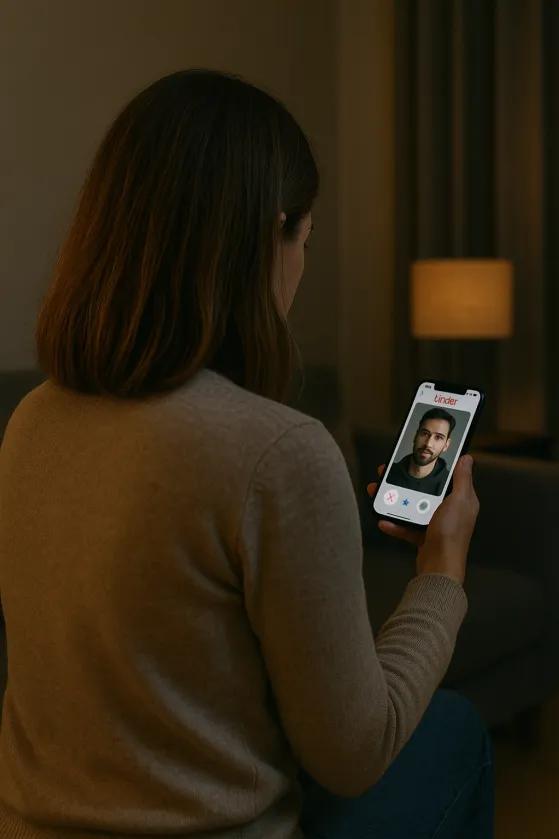
Jessica’s Story: Finding Her Husband on Tinder
When Jessica discovered her husband’s Tinder profile, her world fell apart. Here’s how she found out, what she learned, and how she moved on.